

It is very difficult not to have heard about ChatGPT, a chat system that has artificial intelligence, which leaves no one indifferent.
What is ChatGPT?
A chat system, developed by OpenAI in 2022, that offers detailed answers using a language model, adjusted with both supervised and reinforcement learning techniques. In practice, it is possible to ask it to write a text on a specific topic and the final result will be with accurate information and with the tone you choose, informal or perhaps more academic, it writes it without problems.
Like any other AI, it is “trained” with text, asking questions and adding information. In this way, and through corrections, it is “trained” to perform the task for which it has been developed.
Is it free?
There are two versions, GPT-3.5 and GPT-4. The latter is the paid version (about $20 per month), with more capabilities and more advanced features. However, it is possible to use it in free alternatives such as the Bing search engine chat.
Since last March, it has been possible to use plugins, some of which offer the possibility of connecting to the Internet to have answers with more up-to-date information.
Where to start
It is necessary to register for free at https://chat.openai.com. When you log in, it is possible to ask any question, in Spanish or any other language. It also offers some examples to break the ice.
As we mentioned before, for the “training” of the AI, everything you write will be recorded, and it is not advisable to share sensitive information, something that some countries such as China, Iran or Italy have taken into account, which decided to limit the service accessed by millions of people.
You can start with the simplest thing, have it explain anything, event, have it make comparisons of products, ask it for a couple of lines of code or have it write a song about the topic you want. Who knows, maybe it will help you launch the new summer hit and surpass Leticia Sabater, and her single “Barbacoa al punto G”.
We wanted to ask it about “what is an IT consultancy”. And after its first answer, we asked it to explain it to us as if we were a five-year-old child.
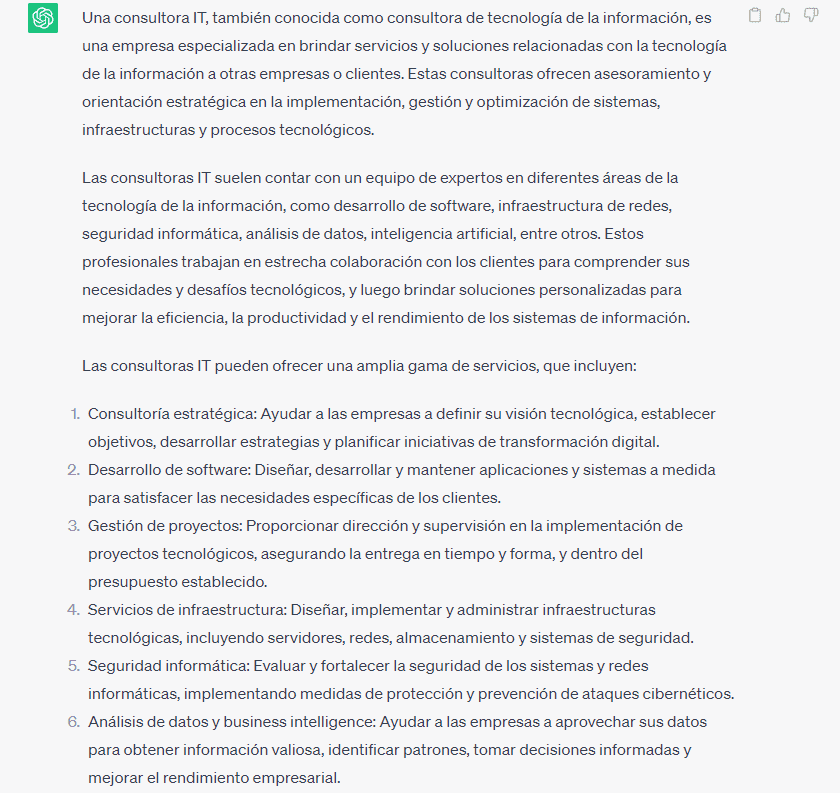
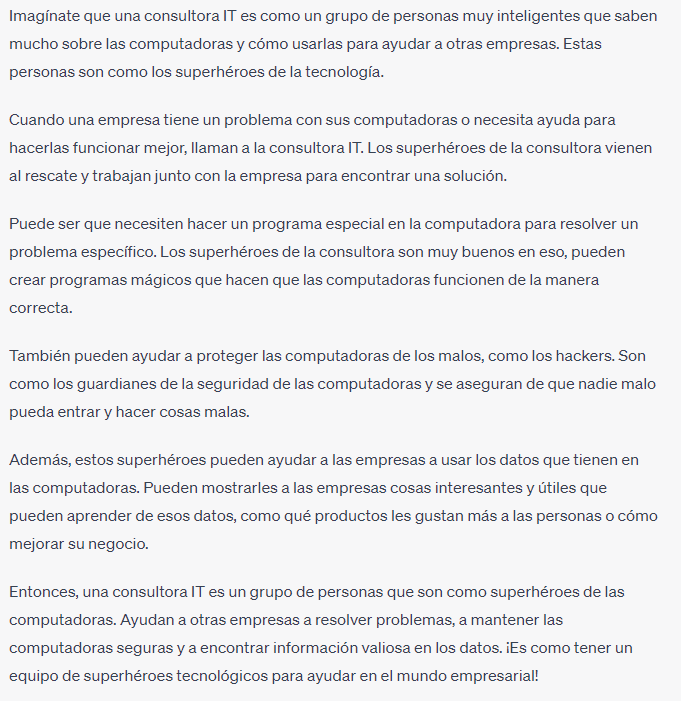
As you can see, it is a tool that offers endless possibilities and that can sometimes make it difficult for us to recognize what has been written by a person or by an artificial intelligence. Luckily, OpenAI has thought about this, and has a free tool, OpenAI Classifier.

When I tested it with this text, it recognized me as a human being, so I am jumping for joy.
The classifier considers the text to be very unlikely AI-generated.
Who is behind OpenAI?
Mira Murati (Vlorë, Albania December 16, 1988), software developer, and current CTO of the company. She studied Mechanical Engineering at Dartmouth College and worked at Zodiac Aerospace, the augmented reality company Leap Motion, and Tesla, where she became product manager of Model X.

She is currently also in charge of DALL-E, an ambitious parallel project of the company designed to create works of art from AI.
Last February she was on the cover of Time, and as a curiosity when asking ChatGPT about her, it will tell you that it does not know who she is. Her public appearances are limited, you can see interviews such as the The Daily Show from last year, an American late-night show
Uses of ChatGPT in programming
As we have mentioned, the Artificial Intelligence chatbot offers several practical uses, and for programmers (and developers) it has some interesting functionalities:
-
Add placeholders and filler content SQL, JSON, CSV and other formats
The insertion of placeholders and filler content is common when working with databases and information exchange formats. ChatGPT can automate this process by generating accurate placeholders and dummy content in formats such as SQL, JSON, and CSV. For example, when working on a web application, you can request it to automatically generate test values for a user table in JSON format, thus speeding up the testing and development process.
-
Translate the code to another language
Imagine you need to translate a function from Python to Java for a joint project. With ChatGPT, you simply provide the code in Python and get the corresponding translation in Java.
-
Optimize code blocks
It can also suggest optimizations. Suppose you have a code block that sorts a list of numbers. The chatbot could suggest a more efficient sorting technique, such as QuickSort, instead of BubbleSort, thus improving the performance of your program.
-
Detect and correct code errors
Code errors are common and often consume valuable debugging time. By providing a code snippet to ChatGPT, it can point out potential errors and suggest corrections. For example, if you have a syntax error in a JavaScript function, it can tell you the exact line where the error is and offer a suggestion as a solution.
-
Generate code from scratch
You can ask it to create a program skeleton in a specific language. Suppose you want to start a project in Python to analyze CSV data. With ChatGPT, you can get an initial snippet of code that imports the appropriate library, loads the CSV file, and displays the first records.
ChatGPT and the future of data programming
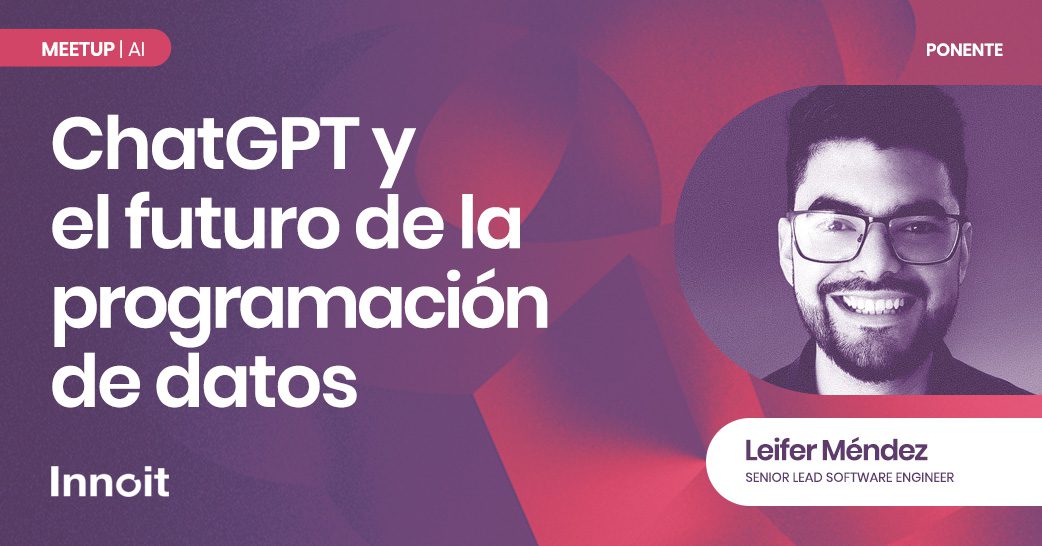
The future of programming is in data and one of the key areas that is driving this change is artificial intelligence. Leifer Méndez (Senior Lead Software Engineer), spoke to us at one of our events, about the technologies and tools needed to work with AI, also exploring the impact and transformation that these new concepts are having on programming and how programmers can prepare for the future and develop skills in the field of AI.
This talk is available on ourYouTube channel.
ChatGPT not only envisions the future of data programming, but is building it. It is undeniable that the synergy between AI and data programming will lay the foundation for future discoveries and achievements.


