

Behavior-Driven Development (BDD) has gained a prominent place in the software development landscape, with modern teams enthusiastically adopting the mantra “we must start with BDD.” Despite its popularity, the implementation of BDD brings doubts and challenges, especially when it comes to avoiding bad practices. In the following lines, we will attempt to demystify BDD, sharing fundamental aspects, usage experiences, best practices, and a demonstration of its application in the real world.
The concept
BDD is a software development process that fosters collaboration between developers, QA, and non-technical staff through the use of scenarios and tests written in an understandable language. This methodology ensures that all stakeholders have a clear understanding of the project requirements, thus promoting more efficient and effective development.
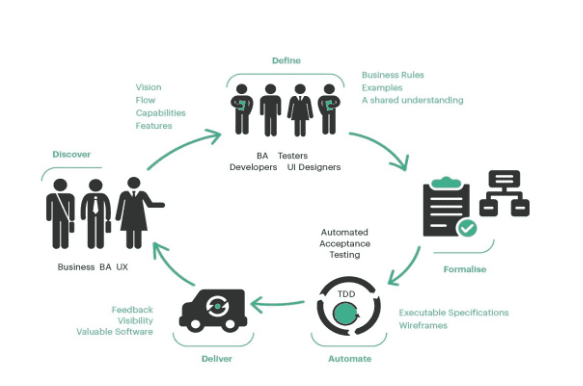
A bridge between business and technology
BDD focuses on the use of a common language to describe software requirements, allowing everyone involved to clearly understand what should be developed. This collaborative approach ensures that the final product meets business expectations, reducing misunderstandings and rework.
BDD improves software quality
By starting development with behavioral specifications, BDD allows teams to clearly define and understand acceptance criteria before writing code. This leads to a more test-oriented approach from the start of the project, ensuring more complete test coverage and early error detection.
The collaborative integration of BDD facilitates active participation
The inclusive nature of BDD encourages active participation from all team members, from business analysts to developers and testers. Tools like Serenity BDD help automate acceptance tests based on agreed specifications, thereby promoting greater collaboration and mutual understanding.
BDD streamlines the development process
Compared to more traditional methodologies, BDD simplifies and streamlines the development process. By eliminating the need for extensive documentation and focusing on clear and concise specifications, teams can move faster while maintaining high quality standards.
Catalyst for innovation and continuous improvement
BDD not only improves communication and collaboration but also establishes a constant feedback loop. Through continuous review of acceptance criteria and test results, teams can adapt and improve iteratively, ensuring that the final product truly meets user needs.
Sharing experiences and best practices
Successful BDD implementation depends on adhering to certain best practices. These include clearly defining acceptance criteria before starting development, close collaboration between all team members, and adopting a common language to eliminate ambiguities. In addition, it is crucial to integrate automated tests from the beginning to continuously validate requirements as the project progresses.
Practical demonstration with Serenity and Cucumber
An effective way to understand the application of BDD in real projects is through a practical demonstration. Integrating Serenity BDD with Cucumber offers a robust framework for implementing BDD, allowing teams to write test scenarios in natural language that are then automated. This combination not only facilitates the definition of tests based on the expected behavior of the software but also improves communication within the team and with stakeholders.
Let’s consider a simple exercise: developing a shopping cart feature for an e-commerce website. Using BDD with Serenity and Cucumber, the team starts by defining the cart’s usage scenarios in natural language, covering both happy paths and exceptions. These scenarios are then translated into automated tests, ensuring that development aligns closely with end-user expectations.
The Future of Software Development with BDD
The implementation of BDD represents a significant cultural shift within development teams, emphasizing clarity, collaboration, and quality. Through its practical approach and supporting tools, BDD offers a clear path towards more efficient and effective software development. With the adoption of methodologies like BDD, teams can not only face the current challenges of software development but also adapt to the changing demands of the future.
The integration of BDD in development projects not only facilitates better communication and understanding among team members but also paves the way for the incorporation of technological advances such as artificial intelligence, maximizing the efficiency and quality of the software delivered.


