

At one of our latest events in Barcelona, we had the opportunity to explore the potential of large language models (LLM) in the analysis and processing of business data.
The talk, given by Albert and Antoine (Neosoftia), offered valuable insights into how these tools can transform data management in companies of all sizes. Here is a summary of the key points in blog style so you can better understand why this is relevant to your business.
What is an LLM?
Large Language Models (LLM) are highly sophisticated artificial intelligence systems designed to understand, generate, and translate text on an unprecedented scale. These models learn the complex structure of language from vast datasets, allowing them to perform a wide range of language-related tasks.
The “Hype” around LLMs
Enthusiasm for LLMs has grown exponentially, driven by their potential to revolutionize the way we interact with technology, process information, and automate tasks. This trend is supported by the promise of efficiency and natural language understanding that surpasses anything seen before.
Current trends
Current trends in Large Language Models (LLM) are shaping the future of artificial intelligence, taking it to new frontiers of efficiency and versatility. These advances not only increase the ability of LLMs to understand and generate text, but also expand their applications in the business environment. Below are some of the key trends:
- Multimodality: Models like GPT-5 and Gemini are designed to understand and generate not only text, but also images, audio, and video, creating richer and more complex user experiences.
- Small Language Models (SML): Mistral-7B, Falcon-7B, and Phi 2 show a focus on lighter models that maintain high performance with less demand for resources, facilitating their integration into business applications.
- Specific LLMs: Tools like BloombergGPT and Google’s Med-Palm offer customized solutions for specific industries, leveraging specialized data to generate highly relevant analysis and responses.
- Search for Current Affairs: Models like Perplexity are being trained with continuously updated data to ensure that the information generated is relevant and reflects the latest trends and knowledge.
- AI Agents towards AGI: The trend towards the development of artificial intelligence agents that approximate a General Artificial Intelligence suggests a future where LLMs can learn and perform a wide range of tasks across different domains.
How are LLMs Trained?
LLMs are trained using large amounts of digital text, learning language patterns through techniques such as supervised learning and self-learning. This process allows them to predict the next word in a sentence with surprising accuracy, which is the basis for generating coherent and relevant text.
How can they help my business?
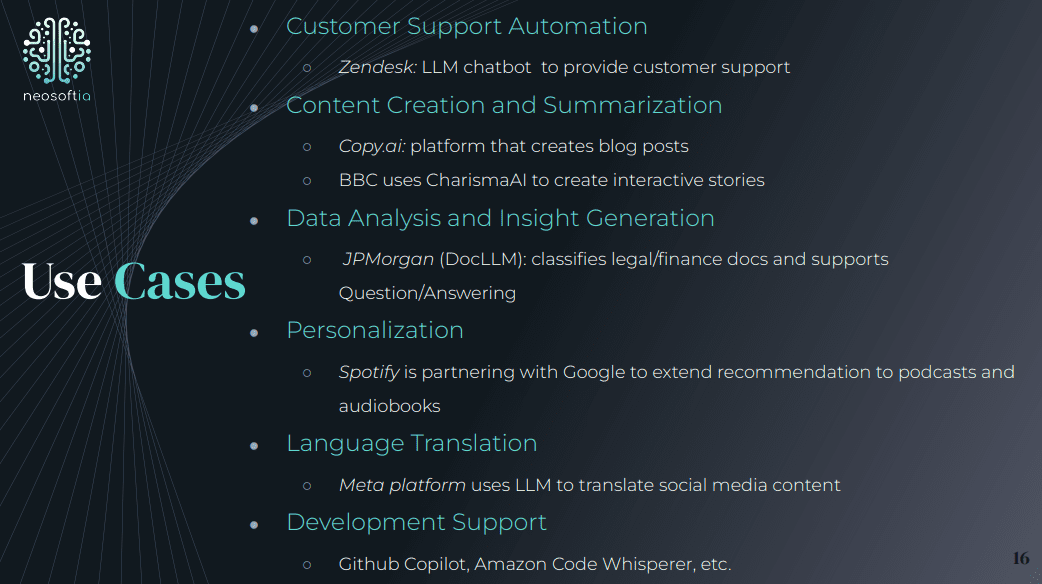
LLMs can transform the way companies interact with their data, automating content generation, improving customer service through intelligent chatbots, and offering deep insights from large volumes of unstructured text.
From automating customer support to generating content and analyzing sentiments, LLMs find applications in a wide range of areas within the business environment, improving efficiency and providing new capabilities that were previously impossible.
List of use cases presented by Neosoftia:
Challenges
Despite their advantages, LLMs present challenges such as the need for large computational resources, the risk of reproducing biases existing in the training data, and the importance of interpreting and ensuring transparency in their processes and decisions.
Four ways to use an LLM
When considering the integration of Large Language Models (LLM) into the business environment, it is crucial to understand the various strategies available for their implementation. Each approach offers unique advantages and adapts to different needs and objectives.
- Out-of-the-box: Direct use of pre-trained models.
- Fine-tuning: Adjusting models to specific needs with own data.
- Pre-training: Training from scratch for highly specialized requirements.
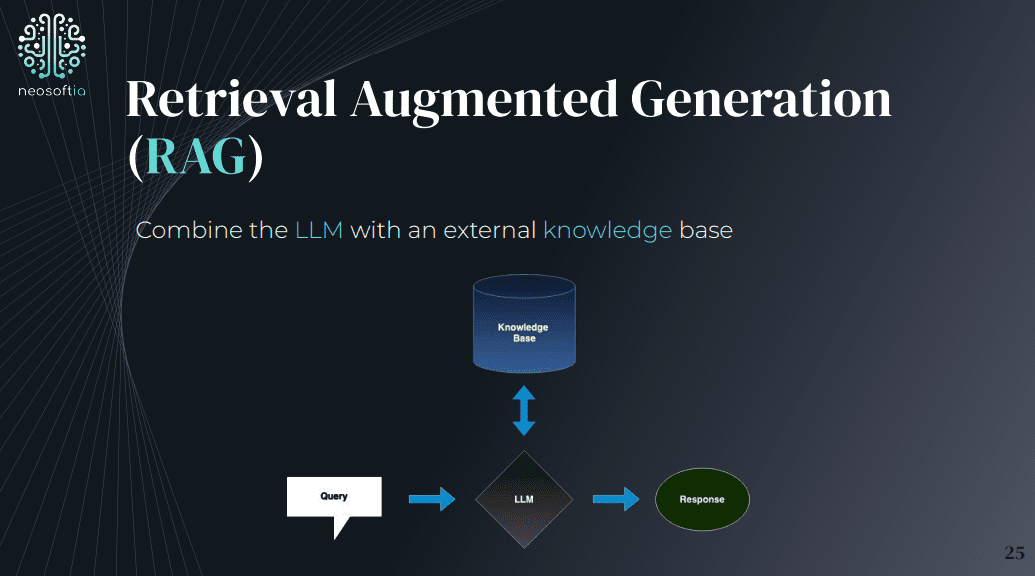
- Retrieval Augmented Generation (RAG): Combination of LLM with external knowledge bases for specific and updated responses.
Naive RAG vs. Advanced RAG
The difference between a naive and an advanced RAG approach lies in the complexity and personalization of the system to integrate and leverage specific company data, significantly improving the relevance and accuracy of the generated responses.
LLM Evaluation
The effective evaluation of an LLM involves comparing its performance in specific tasks, the quality and relevance of its responses, and its ability to integrate seamlessly into existing business processes.
Conclusion
LLMs are on the verge of radically transforming the way companies access and use their data. Despite the challenges, their ability to understand and generate language offers unprecedented opportunities for automation, innovation, and efficiency.
As the field evolves, companies that adopt these technologies will not only be able to improve their current operations, but also discover new ways to interact with their customers and analyze complex data, opening doors to unexplored market strategies and lasting competitive advantages.
Adaptability and willingness to experiment will be key to maximizing the potential of LLMs, turning challenges into opportunities and leading the forefront of technological innovation in the business environment.
You can watch the full event from our YouTube channel. You can download the presentation from here.


